
The best time to leave, and the reason why
The Departure Advisor tries a departure every 30 minutes for the next 72 hours, follows each one along your route, and ranks them against the wind, gusts, seas and visibility you're happy with. Then it tells you when to go, and the one condition that decides it.

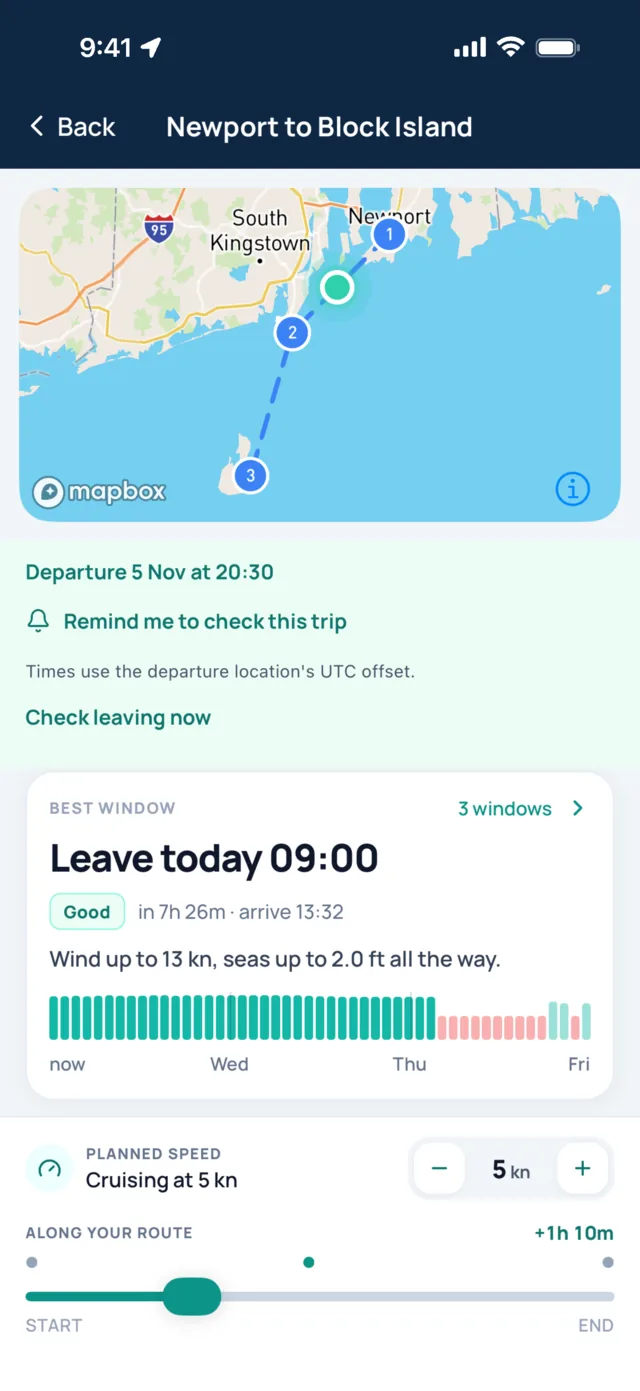
How it finds your window
Most forecasts tell you about the harbour at the moment you cast off. The Departure Advisor sails every candidate departure through the forecast, leg by leg, and judges the whole trip.
Draw your route
Tap waypoints on the map, or open a saved plan. Two points are enough; a coastal hop with a headland and an inlet usually wants four or five.
Set speed and limits
Your cruising speed sets the arrival time at each waypoint. Your comfort limits set what counts as too much.
Every departure, tested
A departure every 30 minutes across 72 hours. For each one, the forecast at every point of the route for the time you'd be there.
Read the answer
"Leave Sat 07:00", the condition that limits it, what changes if you leave later, and the other windows in the next three days.
Your limits, scaled to your boat
Pick Relaxed, Moderate or Experienced and Sea Window sets starting numbers for your boat type and length. A planing powerboat feels the sea long before the wind, so its limits start lower than a sailboat's. Under 7 metres the sea limit drops by a fifth; at 12 metres and over it rises by a quarter. Change any number and it becomes your own set, synced to your account.
Any departure with a single leg over your limits is marked rough, however good the rest of the trip looks.
| Relaxed | Moderate | Experienced | |
|---|---|---|---|
| Max wind | 15 kn | 20 kn | 25 kn |
| Max gusts | 20 kn | 27 kn | 33 kn |
| Max seas | 1.0 m | 1.5 m | 2.5 m |
| Min visibility | 5 km | 3 km | 2 km |
| Relaxed | Moderate | Experienced | |
|---|---|---|---|
| Max wind | 12 kn | 16 kn | 20 kn |
| Max gusts | 18 kn | 23 kn | 28 kn |
| Max seas | 0.6 m | 1.0 m | 1.5 m |
| Min visibility | 5 km | 3 km | 2 km |
Every condition that can spoil a passage
Each departure is scored on the average and the worst of what you'd meet along the way, and compared point by point with your limits.
How to compare departure times yourself- Wind and gustsSustained wind and gusts at every point of the route, for the hour you'd be there.
- SeasSignificant wave height along the route, with the period shown so you can tell swell from chop.
- VisibilityFog and haze in nautical miles or kilometres, checked against your minimum.
- ThunderstormsConvective risk from the forecast, hour by hour along the trip.
- Tidal currentsNOAA current predictions within 5 nautical miles of the route in US waters, ocean-model currents elsewhere. The strongest current and wind against current both count.
- Model agreementWhether GFS, ICON and ECMWF tell the same story for that day.
- Official warningsAny National Weather Service marine warning in force on the route.
One headline, one reason, no guesswork
The best window comes first, written the way a skipper would say it. Below it, a strip of the passage coloured against your limits, with the limiting point marked, and the badges that tell you how much weight to put on it.
- HeadlineWhen to leave and when you'll arrive.
- ReasonThe windiest hour, the biggest seas, the strongest current, or wind and seas inside your limits all the way.
- Leaving laterWhat changes if you go after the window closes.
- Other windowsEvery other window in the next 72 hours, in compact rows.
- No window?The least rough option, labelled as such, with what goes over your limits.
Leave Sat 07:00
Arrive 13:20 at Block Island
Biggest seas around 11:00: 2.6 ft.
Leave after 10:00 and the wind runs against the current.
Along your route
Departure Advisor questions
How far ahead does the Departure Advisor look?
It tests a departure every 30 minutes across the next 72 hours, and follows each one along your route for as long as the trip takes at your speed.
What if no departure fits my limits?
You get the least rough option, labelled as such, with the condition that goes over your limits and when. Change your speed, split the trip into shorter legs, or look again when the next forecast comes in.
Does it include tidal currents?
Yes. In US waters it uses NOAA tidal current predictions from stations within 5 nautical miles of your route. Elsewhere it uses ocean-model currents. A badge on each answer tells you which, and wind against current is called out by time.
Does it work for powerboats and sailboats?
Yes. Your boat profile sets the starting limits, and your cruising speed sets the timing. Trawlers and other displacement boats hold a steady speed, which makes the arrival times especially accurate.
Can I compare two specific departure times?
Yes. Pick the times you have in mind and Sea Window lays them side by side: wind, seas, visibility, current and how each compares with your limits.
Can it remind me to check again?
Yes. Set a reminder on a planned trip and Sea Window nudges you to look again before you leave, when the forecast is fresher.
Guides on timing a passage
How to find a weather window for a coastal passage
Turn a forecast into a window that covers the whole trip, including a slow arrival.
Passage planningHow to compare departure times
Score each departure for the whole trip, not just the hour you cast off.
Tides and currentsWind against tide: why the sea stands up
What an opposing current does to waves, and how to time an inlet or a headland around it.
Passage planningHow to plan a coastal passage
From route and timing to tidal gates, bolt holes and the final check before you leave.

Pick your window before you cast off
Your route, your limits and the next 72 hours, ranked in seconds.